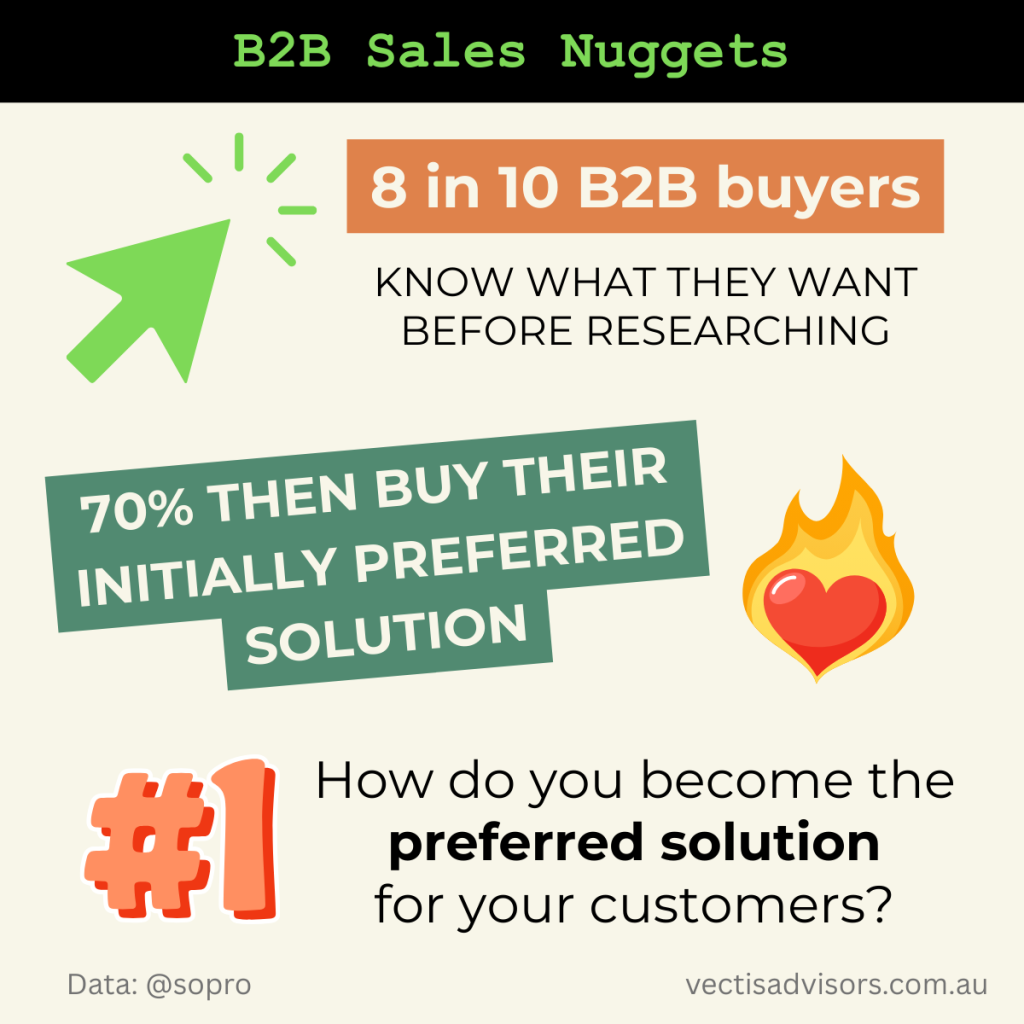
Recent statistics have shown that 80% of business-to-business buyers know what they want before researching for who to buy it from.
What does this mean for a sales team generating new business?
Maybe that 80% figure shouldn’t be so surprising as studies over some years now have shown that buyers are conducting the majority of their buying process before they ever contact a supplier.
I guess we should differentiate here between a re-buy situation by an existing customer versus a customer/prospect sourcing a solution (product or service) that isn’t regularly required.
Let’s focus on the customer sourcing a new solution.
The fact is the buyer is doing their homework to identify their own requirements before seeking a supplier.
That’s why B2B sales teams now must be prepared to add insights and value immediately when speaking with prospects. The old-fashioned idea of using small-talk and building a relationship doesn’t create the same traction that it used to.
STuart Ayling
Sure, you still need to build a relationship – but it is now more of a relationship of value, not of affinity.
And the fact that 70% of buyers then continue on to buy what they originally had in mind shows how hard it can be to switch the customers mindset to a new offering.
Which leads us to the question of: How to get on the customers shopping list in the first place?
Ideally they would know about you and what you can provide before they get committed to another solution. You need to be in the ‘consideration set’ for that customer. That is, be part of the small number of suppliers the prospect has in mind for a particular type of purchase.
The answer isn’t simple. Marketing and sales functions need to work together to ensure communication with the right decision-makers can happen.
The marketing team should be clear about the ideal customer profile and create various forms of marketing material that resonates with that audience.
The sales team should incorporate the marketing resources into their communication activities to add strength to their personal outreach and sales conversations.
Overall, from my experience working with many expertise-based B2B sales teams, I see communication with prospects is mainly managed by, and is the responsibility of, the sales team.
For expertise-based businesses sales team members may hold a title of Area Manager, Product Specialist, Technical Support, Account Manager or even Branch Manager (who also manages a sales territory). No matter the title these roles usually have the major connection and relationship with the customer.
Each member of the sales team therefore should have a strategy about how they will begin to influence prospects (currently not customers) to develop a relationship of value and get into the prospects consideration set.
You can become the preferred solution by maintaining regular contact, demonstrating you can actually help them with their challenges, and gradually building the trust and creating awareness so you are at the top of the prospects list of people to contact when they next need your type of product or service.

About the author
Stuart Ayling MIMC, BBus, GCM holds a Bachelor of Business (Marketing) and a Graduate Certificate in Management (International Business). He is an experienced strategic planning facilitator/consultant, and trainer in business-to-business sales, critical thinking skills, and management skills. For over 20 years he has been engaged by a wide range of national companies, regional firms, and founder-led businesses across Brisbane, Sydney, and Melbourne. He is also a full member of the Institute of Management Consultants (Australia).