What happens after you create your strategic plan?
You might think the answer is obvious… but it’s not.
When business leaders decide they need to create a strategic plan it’s usually in one of two scenarios. It’s either creating a strategic plan for the first time, or it’s updating an existing or outdated plan.
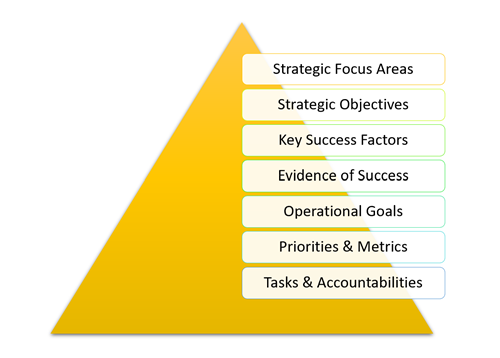
To be clear, the term ‘strategic planning’ is being used here to encompass the process of defining the Vision, Strategic Focus Areas, Strategic Objectives, Evidence of Success, and Key Success Factors. After that follows more detailed operational-level planning.
First time planners
One thing I’ve noticed when working with businesses to create their first strategic plan is there can be a lack of forethought about what should happen afterwards. Due to this being the first time, organisational leaders haven’t figured out how they will move the plan forward.
This can be true no matter the size of the business or how long it has been operating for. It’s part of the organisational learning curve.
Due to its ‘strategic’ perspective a strategic plan doesn’t always drill down into the detailed tasks and responsibilities of who will do what and by when. Although this can start to be addressed as part of the strategic planning process (which I often do) there are limitations on the time available to do this to the level of detail required during the strategy development process.
Additionally, during the strategy development process it’s often the case that numerous strategic priorities in the form of Strategic Focus Areas and Strategic Objectives are identified. However the sense of prioritisation isn’t always available at this stage of the planning process. So it can be unclear which initiatives should get most attention first.
The worst-case situation is where the company invests the effort to create a meaningful strategic plan but then sits on the plan because the focus for taking action isn’t clear. That’s such a wasted opportunity.
Strategic plan revisions
When strategic plans are updated, or completely revised, there’s often some hangover from previous priorities and vested interests in whatever was on the original plan.
As a result, when there are new initiatives developed as part of the strategy development process it can be difficult for the people involved (leaders and team members) to fully commit to the new initiatives.
There may also be a sense of conflict and possibly self-protection in not committing to more outcomes than are already on the table. This can create feelings of stress. The cause of that conflict or stress is usually a lack of focus, which leads to a lack of priorities.
The point of undertaking strategic planning is that it creates focus and enables leaders to make decisions about allocating resources to pursue certain outcomes.
The process and outcomes can also be motivating for team members as everyone can understand what is being done and why (as long as it is communicated well).
As with first time planning, there can be a lack of action after the strategic plan is prepared due to a lack of commitment to fully embrace the new or revised initiatives. As always, time is required to fully develop realistic action plans the team can support, and decisions must be made about who will do this operational-level planning.
The ‘Strategic Stagnation’ gap
I call the blockage, or slowdown, between creating the strategic plan and creating meaningful operational plans ‘Strategic Stagnation’.
It’s the extra effort required beyond the initial planning workshop – in time, personnel and resources – to define specific tasks, workable deadlines, and accountabilities that creates friction and is where strategic stagnation comes into play.
It can be exciting and inspiring to plan the future. New doors can be opened. New challenges need to be overcome. But once the new direction and Strategic Objectives have been identified it’s important to reflect, prioritise, and allocate (the RPA process).
Reflect
- What do these new goals mean for us?
- How different will this be to what we have done before?
- How do we foster a mindset that is supportive of taking on the new challenges?
- Who should be involved in taking the next steps (to do the operational-level planning)?
Prioritise
- On what basis will we prioritise the numerous Strategic Objectives we have developed?
- Which objectives will have the most impact on our success?
- How far in advance can we plan our priorities?
Allocate
- Who will be required to do the planning?
- Do they have the authority, skills and influence to make these decisions?
- How will the workload be altered to enable the new initiatives to be handled?
- How is progress being monitored and reported?
To avoid the strategic stagnation gap there is a lot consider.
Turning strategy into action
I suggest an effective and practical approach is to pre-empt these issues by giving some thought in advance to ‘what will happen next?’.
Maybe you can create an implementation team that is charged with taking the new strategy outcomes and going through the Reflect, Prioritise and Allocate process. You can create the expectation that not everything coming out of the strategy development process will be actioned immediately. You can set expectations of a time frame for progress.
Importantly, by addressing the strategy stagnation gap you can optimise team morale as they will see that proactive steps are being taken to move the business forward. Conversely, it can be demoralising for team members to invest their efforts and emotions in strategy work only to see the outcomes get ignored because everyone is already too busy to do anything about it. A wasted opportunity.
From the strategy development process you should expect to identify new opportunities. You should also expect to devote extra effort to translating the strategic opportunities into meaningful and realistic operational action plans.
It’s a plan for the future
Lastly, remember that strategic plans generally look at least a few years ahead. Consequently, the outcomes identified from the strategy development process are to be addressed over a number of years.
Try to avoid feeling pressured to do too much, too soon. That can easily lead to overwhelm, stress, and inaction. Instead, use the RPA process to make impactful decisions and create an environment where your whole team is excited to be on the journey to the future.
Would you like help with your strategic planning process? You’re welcome to get in touch to arrange a confidential initial discussion.

About the author
Stuart Ayling MIMC, BBus, GCM holds a Bachelor of Business (Marketing) and a Graduate Certificate in Management (International Business). He is an experienced strategic planning facilitator/consultant, and trainer in business-to-business sales, critical thinking skills, and management skills. For over 20 years he has been engaged by a wide range of national companies, regional firms, and founder-led businesses across Brisbane, Sydney, and Melbourne. He is also a full member of the Institute of Management Consultants (Australia).